EMTs and paramedics deploy to disasters in five ways. Three run through the service you work for or a government team: FEMA’s National Ambulance Contract, a state ambulance strike team, or a federal Disaster Medical Assistance Team (DMAT). The other two are private disaster staffing companies and wildland fire medical crews. Most disaster deployment work for EMTs comes through your employer, not a job posting. It’s one kind of contract EMT work, with its own rules on pay, notice and your day job.
The short version, as of November 9, 2026:
- Length: strike teams deploy for up to 14 days, and DMAT members stay on site for up to two weeks.
- Pay: whoever employs you on the deployment pays you, with overtime after 40 hours a week for most private-sector crews.
- License: BLS strike teams run on EMTs. DMAT’s clinical positions start at paramedic.
- Season: June 1 to November 30 in the Atlantic, peaking around September 10.
- The FEMA contract: the current one is set to run through April 30, 2027.
The 5 ways to deploy
The five routes differ most in who employs you while you’re deployed. That decides who pays you, which license you need and whether your regular job is protected.
| Route | How you get on | License | Typical length | Who pays you |
|---|---|---|---|---|
| FEMA National Ambulance Contract | Work for the contract holder or a service that deploys under it | EMT on BLS trucks, paramedic on ALS | Days to weeks, per order | Your ambulance service |
| State ambulance strike team | Your agency joins the state system and puts you on its roster | EMT and up on BLS teams; a paramedic on every ALS truck | Up to 14 days | Your agency, which the requesting state repays |
| Disaster Medical Assistance Team (DMAT) | Apply on USAJOBS (keyword “NDMS”) | Paramedic and up for clinical positions | Up to 2 weeks on site | The federal government, as an intermittent employee |
| Disaster staffing company | Join a “deployable” or “reservist” roster | Varies by company | Varies | The company, often only while deployed |
| Wildland fire medical | Fire crews and fireline medical units | EMT and up | A fire season | Your crew’s employer |
Deployment work rarely shows up as its own job listing. On November 8, 2026, none of the 1,024 distinct listings on our board had “deployment”, “disaster”, “FEMA” or “strike team” in its title.
1. FEMA’s National Ambulance Contract
FEMA’s National Ambulance Contract sends private ambulances and crews when a state asks the Federal Emergency Management Agency for help moving patients. You don’t sign up with FEMA. You deploy as an employee of the company that holds the contract, or of a service that deploys under it.
- What it is: FEMA’s health and medical support plan lists “private vendor ambulance support” for moving patients. One private ambulance company holds the current contract, awarded in April 2022.
- When it ends: the current contract year runs May 1, 2026 to April 30, 2027. FEMA asked industry for input on the next contract in April 2026, but we found no solicitation as of November 9, 2026. Who holds it after April 2027 is open.
- How busy it gets: FEMA’s orders under it covered four storms in 2024 (Debby, Francine, Helene and Milton) and one Kentucky flood in February 2025. No response orders were posted for 2026 as of November 9.
To get on, ask your service whether it deploys on the FEMA contract and how its deployment roster works. A travel EMT who hosts a travel EMS channel on YouTube (Oct 2026) said their home company “also are contracted with FEMA.” A deployment, they added, only “comes up when it happens.”
A FEMA reservist is a different job. Reservists are FEMA’s own intermittent, on-call employees, and FEMA says they aren’t guaranteed regular hours.
2. Ambulance strike teams and state task forces
An ambulance strike team is five or more ambulances of the same type, with common radios and a leader in a separate command vehicle. States build them from public and private services, and you join through your agency, not as an individual.
FEMA’s national standard (April 2024) sets the crew:
- BLS team: 5 EMTs, AEMTs or paramedics, plus 5 more crew who can be EMS vehicle operators, EMRs or higher.
- ALS team: 5 paramedics, plus 5 more crew on the same terms, so an EMT can ride as the partner.
- Size and hours: at least 11 people with the leader, shifts of up to 12 hours, deployable for up to 14 days.
- Task force: any mix of 5 ALS and BLS ambulances with a leader.
How a strike team gets sent:
- Local and regional mutual aid goes first.
- Inside a state, the state system moves teams. Texas’s Emergency Medical Task Force lists more than 700 signed agreements with fire, EMS and hospital agencies.
- Between states, the Emergency Management Assistance Compact (EMAC) needs a governor’s emergency declaration first. The service that sent the team is repaid through its own state.
Under EMAC, your home-state license counts in the state that asked for help, within conditions its governor can set.
To lead a team, FEMA’s Ambulance Strike Team Leader standard (September 2025) asks for three years of EMS experience and one year of leadership. It adds five FEMA courses: ICS-100, ICS-200, ICS-300, IS-700 and IS-800. California also requires its leader course, a task book, evaluations from real or training deployments and an employer’s letter.
3. NDMS and the Disaster Medical Assistance Team (DMAT)
A Disaster Medical Assistance Team is a federal medical team in the National Disaster Medical System (NDMS). The Department of Health and Human Services (HHS) runs it through its Administration for Strategic Preparedness and Response (ASPR). Members keep their regular jobs and deploy as intermittent federal employees, “similar to military reservists,” in ASPR’s words.
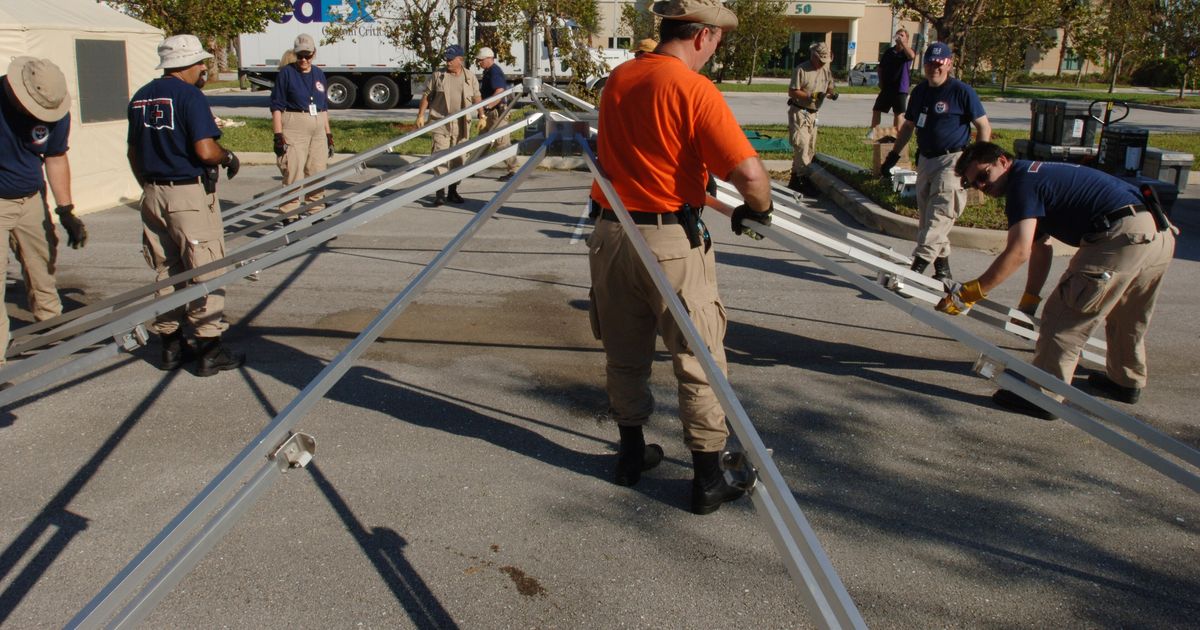
- The work: triage, pre-hospital care, emergency care “at least equal to the services of a basic hospital emergency department,” and patient movement. Teams often set up in tents outside hospitals.
- Who it hires: ASPR’s clinical list includes paramedics, physicians, nurse practitioners, physician assistants, nurses, respiratory therapists and pharmacists, but not EMTs. Non-clinical positions cover command, safety, logistics, IT, communications and admin.
- The commitment: be on call for deployment for at least two weeks, several times a year, and stay on site for up to two weeks. Teams must be self-sustaining for 72 hours, and ASPR warns conditions “can be very austere.”
- The pay: NDMS pays, moves and houses you on federal civil service grades, and you can’t book your own travel. The last NDMS paramedic announcements we found, from December 2022 and February 2023, were for Health Technician (Paramedic), GS-9, at $23 to $34 an hour.
- The protections: the Uniformed Services Employment and Reemployment Rights Act (USERRA) protects your civilian job. Every state recognizes your license while you’re activated, and federal tort and workers’ comp coverage apply.
- How to apply: search “NDMS” on USAJOBS. ASPR says postings stay open about two weeks and the process takes 3 to 6 months.
There’s a catch right now. USAJOBS’ own data on current and past announcements shows no NDMS team postings opened since November 2024 (checked November 9, 2026), while ASPR kept posting other jobs. Save the search so you hear when it reopens.
4. Private disaster staffing companies
Private disaster-response companies keep on-call rosters of EMTs and paramedics and send them out on deployments. Their listings use words like “deployable” and “reservist”, and pay often starts only when you deploy.
In Google’s results for EMT deployment jobs on November 9, 2026, listing titles included “Deployable EMT-Basic Reservist” and “Reservist Paramedic - Deploy on Demand.” One disaster-response listing said staff pay “is activated when they are deployed to a response.”
A private roster isn’t a government program, so check it harder. The government routes leave a trail you can look up: FEMA’s contract is in the federal award record, and NDMS takes applications on USAJOBS. A private “deployment” offer has only the company’s word behind it, so run it past our EMT contract red flags first. Then ask three deployment questions:
- Am I paid between deployments? If pay starts only on activation, your on-call time is unpaid.
- Are travel days and sleep paid? Those hours decide what a deployment week pays.
- W-2 or 1099? A 1099 means no federal overtime. See how travel EMT pay packages work.
5. Wildland fire medical work
Wildland fire is the other big deployment for EMTs and paramedics, on fire crews and fireline medical units through fire season. Wildland has its own hiring track: see how to get a wildland fire job and the wildland fire jobs on our board.
How deployment pay works
Deployment pay is your hourly rate times a lot of hours, and which hours count decides the total. For most private-sector crews, the Fair Labor Standards Act sets overtime at time and a half after 40 hours in a workweek. Paid around the clock, you pass 40 hours on day two.
The rules that move the number:
- The workweek is fixed. It’s a set 168-hour period, and hours can’t be averaged across two weeks, per the US Department of Labor.
- Sleep can come off the clock. On duty for 24 hours or more, you and your employer may agree to leave out up to 8 hours of sleep. That needs adequate sleeping facilities and a night you can usually sleep through. If you get less than 5 hours of sleep, none of it comes off.
- Fire departments count differently. Fire-based EMTs and paramedics trained in fire suppression can fall under the 7(k) rule: overtime after 212 hours in 28 days, or 106 hours in 14 days.
Here is what the sleep rule does at the $26 base an EMT-firefighter described for a FEMA deployment. Example, not a promise: one 7-day workweek, before tax.
| Paid hours a day | Straight time | Overtime at $39 | Week’s pay | Per day |
|---|---|---|---|---|
| 24 (sleep paid) | 40 h = $1,040 | 128 h = $4,992 | $6,032 | $862 |
| 16 (8 h of sleep left out) | 40 h = $1,040 | 72 h = $2,808 | $3,848 | $550 |
That’s a $2,184 swing in one week. Before you go, ask whether sleep is paid and whether travel days count.
Before you deploy: notice, training and your day job
Before the phone rings, get on a deployment roster, finish your incident command courses and know where your regular job stands.
- Notice can be hours. California’s strike team manual (2010) defines “immediate need” ambulances as ready to respond within three hours of a request. One deployment listing seen in November 2026 asked recruits to be within an 8-hour drive of its Florida base.
- Take the FEMA courses now. FEMA’s online, self-paced Independent Study program offers the Incident Command System (ICS) basics, IS-100 and IS-200, plus IS-700 and IS-800. The exams need a FEMA Student Identification number. On November 8, 2026, 54 of the 1,024 distinct listings on our board (5%) named an ICS or IS course like these. “Start stacking up the FEMA Independent Study courses,” the top reply to a careers question on r/EmergencyManagement advised (Nov 2026).
- Know your job protection. USERRA covers NDMS activations and FEMA reservist deployments, so your civilian employer must take you back. After 30 days or less away, you report back at the first full scheduled shift after you get home safely, plus 8 hours of rest.
- Know its limits. Your employer doesn’t have to pay you while you’re away, but it can’t make you use vacation. ASPR notes that USERRA doesn’t cover state or local call-ups.
When disaster deployments happen
Most hurricane deployments come between mid-August and mid-October, when the National Hurricane Center says most Atlantic storm activity happens. The season runs June 1 to November 30 and peaks around September 10.
FEMA’s orders under the ambulance contract follow the same curve: Ian in September 2022, Idalia in August 2023, and Debby, Francine, Helene and Milton from August to October 2024. The February 2025 order was for flooding, and DMATs also cover national special security events. For the rest of the calendar, see seasonal EMT jobs.
Disaster deployment packing list (17 items)
Pack to look after yourself for 72 hours, the self-sufficiency ASPR expects of NDMS teams and FEMA’s standard sets for strike team leaders. This personal list follows the go-kit in the California EMS Authority’s strike team manual (2010), plus ASPR’s license rule. The team carries the medical gear.
- Copies of your licenses and certifications (NDMS requires them)
- Photo ID and some cash
- Personal medications and your medical history
- Extra uniforms and underwear
- Safety boots
- Reflective jacket
- Rain gear
- Clothes for the climate
- Sleeping bag
- Ear plugs
- Sunglasses
- Sunscreen
- DEET insect repellent
- A 1-quart water bottle, full
- 2 MREs
- Toilet paper
- Toiletries
From the field: what deployed medics say
Medics who deploy describe orders that stretch, pay that hangs on paid hours and a calendar they can’t plan. These are individual accounts, not rates or rules.
- The availability form. An EMT-firefighter interviewed on a travel EMS channel (YouTube, Oct 2026) said crews sign a form on arrival saying “you’re available for I think it’s 19 days.” Most of their deployments ran “a couple weeks.”
- Orders get extended. The EMT-firefighter’s longest ran a month, because “two weeks in the second hurricane happened.” The renewal form asked: “Another two weeks, another 5 days, or indefinitely?”
- The pay math. Paid “per 24 hours a day” at $26 an hour, the EMT-firefighter hit overtime “on day two.” It “ends up looking like almost $900 a day,” close to the $862 a day that rate gives when all 24 hours are paid.
- Two weeks is the usual ask. A commenter on r/ems (late 2025) called it “a 14 day commitment that might get cut short.” Most of their deployments came “from August through October.”
- Strangers on one truck. A paramedic on TikTok (Sep 2026), looking back on a Hurricane Helene deployment, said “my partner for the duration of the deployment was an AEMT. We were strangers.”
- Staged before landfall. An ambulance company’s TikTok updates (Oct 2026) put its North Florida crews in “a task force consisting of approximately 30 ambulances.” They stood by after the storm and were home four days later.
- The least predictable gig. The EMT-firefighter called deployments “the most hit or miss” of all contract work.
For steadier work between deployments, browse travel and contract EMS jobs.