Contract paramedic jobs overseas still exist, but the boom of the 2000s and 2010s is over. What’s left: medic slots on US bases, Gulf ambulance services, remote oil and mine sites, rigs, the Antarctic fire department, security teams and aid groups. Most paid postings we read wanted a paramedic card and 2 to 5 years of experience. EMTs get a few base slots, plus volunteer trips that cost them money.
The 8 kinds below run from most to least open to a US-certified medic, by how far your US card gets you.
Is the overseas contract boom over?
Mostly, yes. The Defense Department counted 163,591 contractors in Iraq in late 2007, 31,325 of them US citizens, and 117,227 in Afghanistan in early 2012. By early 2024 it counted about 21,000 across US Central Command’s whole region, which includes the Middle East, and about 48% were US citizens. Those counts cover every trade, from cooks to medics.
One thing still favors Americans: government contract paramedic jobs on bases, on security contracts and in Antarctica take US cards. Elsewhere, the host country’s license rules decide. If you’re weighing contracts at home first, start with how contract EMT work runs, then browse our travel and contract EMS jobs.
Contract paramedic jobs overseas at a glance
| Kind of work | Who hires | What you need | Typical term | Biggest catch |
|---|---|---|---|---|
| 1. Medic on US bases (OCONUS) | Defense contractors | US card, medical, fingerprints; ACLS for most slots | 1 year, often extended | Can end on a month’s notice |
| 2. Gulf ambulance service | Ambulance services, via recruiters | Paramedic, registration, 2+ years | 1 to 3 years | Trial period, modest pay |
| 3. Remote-site medic | Oil, gas and mining medical firms | Paramedic, 5 years acute or remote | 28 days on, 28 off | The only medic on site |
| 4. Offshore rig or vessel | Offshore medical contractors | Paramedic, 2 to 5 years ALS, BOSIET | Hitches of 14 to 28 days | Wants offshore time first |
| 5. Antarctica | US Antarctic Program contractors | Firefighter II, airport and hazmat certs, EMT-B | October to February | The clinics don’t hire medics |
| 6. Protective-security medic | Security contractors | Paramedic, armed protective work, clearance | 1 year, 105 days on, 35 off | A security job first |
| 7. Aid groups and mission trips | NGOs and mission groups | Experience and a long commitment | 4 days to 12 months | Trips cost you |
| 8. Local EMS abroad | National and provincial services | That country’s license, right to work | Permanent | You re-license from scratch |
OCONUS means outside the continental United States. Cruise ships didn’t make the list: the American College of Emergency Physicians’ cruise guidelines (revised May 2026) don’t mention paramedics or EMTs.
What our board shows outside the US
Most overseas paramedic jobs on our board are local jobs, not contracts for Americans. On November 8, 2026, 193 of our 1,232 live listings were outside the US, and 174 of those (90%) were in Canada, Australia, New Zealand or the UK.
| Where | Live listings | What they are | Pay shown |
|---|---|---|---|
| Canada | 137 | Mostly 911 paramedic jobs, 50 of 87 postings in Alberta | Median CA$43 an hour (74 postings) |
| Australia and New Zealand | 22 | Ambulance, clinic and remote-site jobs | Too few to quote |
| United Kingdom | 15 | Ambulance, clinic and offshore jobs | Too few to quote |
| UAE, Bahrain, Kuwait, Saudi Arabia | 10 | Ambulance, fire and security jobs | None posted |
| Iraq and Israel | 4 | Security, site and offshore jobs | Too few to quote |
| Guyana, Germany, Japan, South Korea | 5 | Offshore, fire and EMS jobs | Too few to quote |
Pay counts each posting once, at the middle of its posted range, where at least 5 postings show pay. Canadian pay is in Canadian dollars, and there’s no overseas page on the board yet.
1. Medic on US bases abroad (OCONUS contracts)
Contractor medic jobs on US bases are the most open overseas contracts, because the bases are American and so are the cards they take.
- Who hires: Medical and base-support contractors working for the Defense Department, in places like Kuwait.
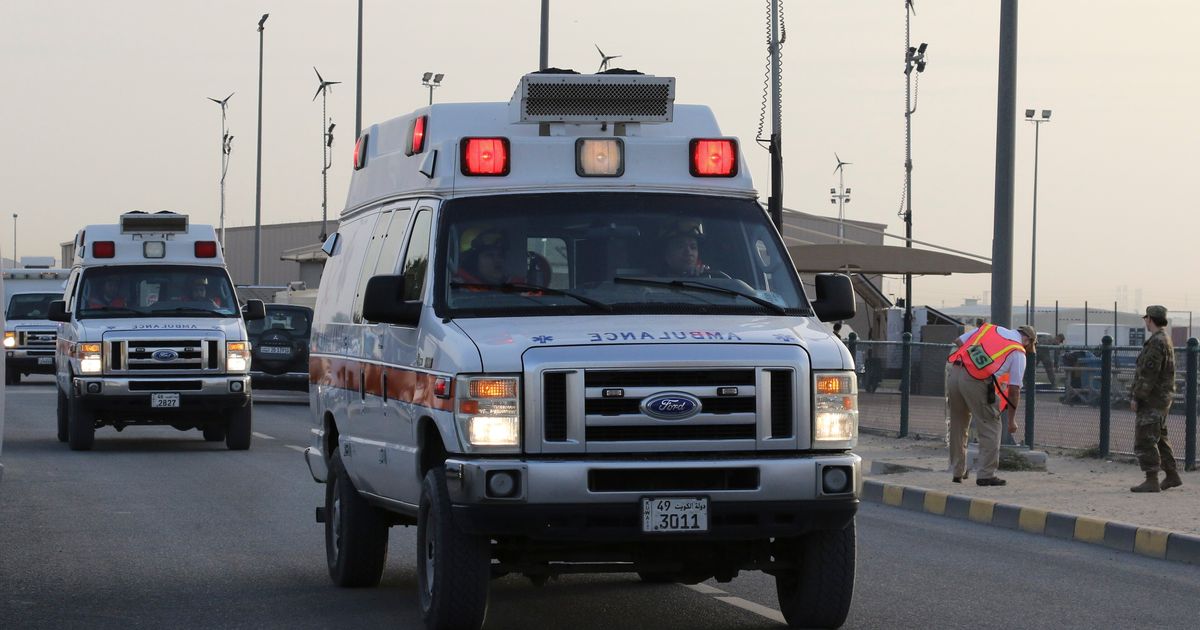
- What you need: A US passport, a medical and a background check. An EMT-B with about three and a half years in US EMS was asked for ACLS (travel EMS channel on YouTube, October 2026). That EMT still got an EMT slot in Kuwait with only BLS. Onboarding took two to three months.
- Term: One year, which most people extend, the same EMT said, working 72 hours on and 72 off, with company housing.
- Pay: About $5,000 a month with overtime, “a little bit lower than expected.” One person’s figure, not a rate.
- The catch: Two months in, war broke out with Iran, the EMT said, and the bases came under missile and drone attack. At six months the company cut staff on about a month’s notice. Injuries on these contracts fall under the Defense Base Act.
2. Gulf ambulance services
Gulf ambulance services hire foreign paramedics on fixed, renewable contracts, and they’re open to US paramedics with a few years on the truck.
- Who hires: Ambulance services and hospitals in the UAE, Saudi Arabia, Qatar, Kuwait and Bahrain.
- What you need: One recruiter’s paramedic listings with Gulf hospitals (checked November 9, 2026) ask for medical education, a valid registration, 2 years in the field and intermediate English.
- Term: 1 to 3 years and renewable, after a trial period of 3 to 6 months.
- Pay: The same listings show $2,900 to $3,900 a month net in the UAE and $3,300 to $5,700 in Saudi Arabia, plus housing or an allowance and flights. None of our 10 Gulf listings showed pay on November 8, 2026.
- The catch: $3,900 a month is $46,800 a year. Set that, plus free housing, against your 911 pay, and ask what happens if either side quits during the trial.
3. Remote-site medic for oil, gas and mining
Remote-site medic work abroad is open to experienced US paramedics, because some operators accept a US registration.
- Who hires: Medical and safety firms staffing oil fields, mines and camps.
- What you need: An oil field posting near Basra, Iraq, with an early November 2026 start, took paramedic registration from the UK, South Africa, Australia, Canada or the US. It asked for 5 years of recent acute, pre-hospital or remote work, plus ACLS and ATLS or advanced PHTLS or ITLS.
- Term: 28 days on and 28 off, for about 6 months.
- Pay: A day rate, with no figure posted. Flights, visas, housing and security escorts were covered.
- The catch: You’re the only medic for up to 40 people.
On November 8, 2026, most remote-site postings outside the US on our board were in Canada and Australia, which register paramedics themselves. At home, see our industrial and site medic jobs.
4. Offshore rigs and vessels
Offshore rig and vessel medic jobs mostly go to paramedics with 2 to 5 years of ALS. They also want BOSIET, the basic offshore safety course, or HUET, its helicopter escape module. Hitches run 14 to 28 days. Certs, hitches and pay are in our offshore medic guide.
5. Antarctica: the fire department, not the clinic
Paramedic jobs in Antarctica mostly mean firefighter jobs, so the ice is open to you only if you’re a certified firefighter too.
- Who hires: The US Antarctic Program (USAP), run by the National Science Foundation, sends roughly 3,000 people a year. Support contractors hire station staff, firefighters included, and a university medical branch staffs the clinics.
- What you need: A McMurdo Station firefighter posting from early 2026 required Firefighter II, airport firefighter and hazmat operations certification, and US citizenship. It preferred EMT-B or higher, and the fire department’s unofficial site lists EMT-Basic as required. The clinic’s job page lists physicians, mid-level practitioners (PAs and NPs), nurses and others, but no paramedics or EMTs.
- Term: Mostly October through February.
- Pay: None of the postings we read showed pay.
- The catch: You must pass a physical qualification review of your medical and dental exams, or win a waiver. A federal appeals court also ruled in 2007 that Antarctica isn’t a foreign country for the foreign earned income exclusion.
For seasonal contracts at home, see seasonal EMT jobs.
6. Protective-security medic
Protective-security medic jobs pay the most of anything we found, because they’re security jobs that need a medic.
- Who hires: Private security contractors, including on State Department contracts.
- What you need: One Iraq posting (checked November 9, 2026) required US citizenship, NREMT-P, ACLS, PHTLS or BTLS, and Tactical Combat Casualty Care (TCCC) knowledge. It also wanted 3 years of EMS, 3 years of armed high-threat protective work and the ability to get a State Department Secret clearance. Army 18D or Navy corpsman time was preferred.
- Term: One year, 105 days on and 35 off.
- Pay: $659 a day, 6 days a week, plus $364 a week in per diem: $4,318 a week. A protective-security paramedic job for an Africa contract, in a public listing on November 9, 2026, was posted at $190,000 a year.
- The catch: Without armed protective experience and a clearance, a paramedic card won’t get you in.
7. Aid groups, NGOs and mission trips
Aid work abroad is open to EMTs as volunteers, but paid aid posts are long, modestly paid and rarely aimed at medics.
- Who hires: Aid groups such as Doctors Without Borders (MSF) and International Medical Corps, plus mission groups for short trips.
- What you need: Experience and time for paid field posts. MSF-USA’s recruiting FAQ doesn’t mention paramedics or EMTs.
- Term: MSF-USA asks new recruits for 9 to 12 months. One mission group’s medical trips run four clinic days.
- Pay: MSF-USA quotes about $2,209 a month to start, plus a field per diem. That mission group’s trips cost you $850 plus a $25 reservation fee and your own airfare.
- The catch: You pay to volunteer, and paid posts take most of a year.
In aid listings, EMT can also mean Emergency Medical Team, a World Health Organization term. “EMT Type 1” is a team classification, like the one the WHO gives International Medical Corps, not a license level.
8. Local EMS jobs in Canada, the UK, Australia and New Zealand
Local EMS jobs abroad are most of the overseas listings on our board. They’re open to Americans only after you re-license there and get the right to work.
- Who hires: Ambulance services, clinics and remote sites.
- What you need: That country’s registration. National Registry certification “by itself, does not give an individual the right to practice,” even in the US, the National Registry says.
- UK: The Health and Care Professions Council (HCPC) assesses your education, training and experience for a non-refundable £678.38 fee, and may set a test of competence.
- Australia: The Paramedicine Board wants bachelor’s-level training to count as equivalent. Associate-level training can count as “relevant,” which means passing an A$3,500 in-person competency assessment.
- Canada: In Alberta, where most of our Canadian listings are, people trained outside Canada apply to the Alberta College of Paramedics through a substantial-equivalence route.
- Term: Mostly permanent. In Canada, 61 of our 87 postings were full time.
- Pay: A median CA$43 an hour in Canada on November 8, 2026, with the middle half at CA$38 to CA$46.
- The catch: It’s a move, not a contract. You re-license before you can apply.
Can an EMT-B get an overseas contract?
Rarely. International EMT jobs and EMT overseas contract jobs are a thin slice. On November 8, 2026, 4 of the 141 postings outside the US on our board named EMT without paramedic, and 112 named paramedic. The doors that open are a few US base slots, the Antarctic fire department for Firefighter IIs, and volunteer trips. Otherwise, become a paramedic and get 2 to 5 years of busy ALS first.
Money and tax: what “tax-free” really means
Overseas pay isn’t automatically tax-free. A US citizen’s worldwide income is generally subject to US income tax, and the foreign earned income exclusion only shelters wages that pass its tests.
- The cap: up to $132,900 for 2026, up from $130,000 for 2025, claimed on Form 2555.
- The tests: a tax home abroad, plus either bona fide residence for a full tax year or 330 full days in foreign countries within a 12-month period.
- The rotation trap: fly home every break on a 105-on, 35-off rotation, and you’re abroad about 274 days a year, short of 330.
- Not covered: US government pay to its own employees, and work in US territories, international waters or Antarctica.
- Still owed: Social Security and Medicare generally still apply with an American employer, and self-employment tax applies on a 1099.
- If you’re hurt: the Defense Base Act covers civilian employees abroad on US military bases or on US government contracts for public works or national defense, whatever their nationality. It pays medical, disability and death benefits, and employers must carry the insurance or be approved to self-insure. Tell your employer in writing within 30 days, on Form LS-201.
This isn’t tax advice: check your setup with a tax professional who handles expat returns.
Overseas scam signs
Walk away from any overseas offer that wants your money first. “Don’t pay for the promise of a job,” the Federal Trade Commission says. The general warning signs are in our guide to EMT contract red flags. Overseas offers add three twists:
- a fee for a visa, a medical or “processing” before you’ve seen a written contract from a named employer
- a “tax-free” promise with no word about the 330-day test
- a base or security job with no medical or background check, when real onboarding took one EMT two to three months
From the field: what medics say about overseas work
Medics who’ve worked abroad describe real money tied to real risk, and doors that close fast. These are individual accounts, not statistics.
- The hype. A TikTok creator (August 2026, about 53,000 views) urged EMTs and paramedics to “become a military contractor,” because “depending on the contract you can make more than some RNs.” The top rates we found came with a clearance and armed security experience.
- The EMT-B who got in. “I was probably the last EMT hired at that time,” said an EMT-B who worked a 2026 base contract in Kuwait (YouTube, October 2026). Older hands had warned that “contracts could just come and go.” That one did.
- The ice. “It’s a paramedic ambulance, nothing special,” a McMurdo Station firefighter said on a YouTube station tour (January 2025). The shift is split between the ambulance and the engine, depending on the call.
- The big-money trap. On r/ParamedicsAU (October 2026), the top answer in a thread on the highest-paid paramedic jobs called the chase “a huge trap”: remote posts, on call, “alone with no backup.”