An event EMT covers concerts, festivals, stadiums, races and other crowds, usually on part-time or per diem shifts (paid per shift, no set schedule). You work for a licensed EMS agency or event medical company, under its medical director and protocols. Pay is mostly hourly, so a shift’s total depends on its length. Without an agency behind you, it’s first aid, not EMS care.
Event EMT work at a glance
Event EMT work is licensed, hourly, often part-time and seasonal:
| Question | Short answer |
|---|---|
| Who hires | EMS agencies, ambulance services and event medical staffing companies that contract with venues |
| License | The event state’s license, or an EMS Compact privilege. National Registry (NREMT) certification alone is not a license |
| Medical direction | The company’s physician medical director and written protocols |
| Pay | Mostly hourly. Posted starting rates we checked in November 2026 ran $18 to $25 an hour, EMT to paramedic |
| Shift length | About 3 hours for a game to 10 hours or more for a festival day, by medics’ accounts |
| Tax status | W-2 employee or 1099 contractor, depending on the company |
| Season | Spring to early fall. Searches for event EMT jobs peak in August and September |
What does an event EMT do?
An event EMT handles a crowd’s medical problems on site and gets the serious ones to an ambulance fast. Most of the job is assessing people, treating minor problems and deciding who needs transport. “Event medic” is the catch-all name for the whole team: EMTs, AEMTs (advanced EMTs), paramedics and often nurses.
Event shifts come in three kinds:
- Standby. You’re posted at a game, race or show with a bag, a cart or a rig. Some standby crews cover only the athletes or performers. When nothing happens, you wait.
- Treatment. You staff a first-aid station or medical tent, or rove the crowd on foot, in a cart or on a UTV (a utility side-by-side). Big festivals add nurses and physicians.
- Transport. You crew a dedicated ambulance on site that takes patients to the hospital or hands them to the local 911 system.
The work happens at concerts, music festivals, sports from high school to pro, marathons and obstacle course races, rodeos, motorsports, conventions and fairs. On film and TV sets, the job is called set medic.
What event EMTs treat
Event EMTs mostly see heat illness, dehydration, alcohol and drug intoxication, and minor injuries such as cuts, sprains and fractures. Cardiac arrests and serious trauma are rare but real. At a big event you may be the first one there.
The hardest calls are often intoxicated patients in the gray zone: alert enough to refuse, too impaired to be safe alone. Your company’s written policy on capacity and release should make that call, not your gut. If there’s no written policy, ask for one.
Event EMT vs event paramedic
An event paramedic does the advanced work: IVs, medications and cardiac monitoring, usually on the ambulance or in a physician-led tent. EMTs staff first-aid stations, roving teams and standby posts. Your license level sets which posts you can fill and what you’re paid.
These are posted starting rates we checked in November 2026, with cents dropped:
| Example posting | EMT | AEMT | Paramedic |
|---|---|---|---|
| A Midwest event medical company’s careers page (page dated 2021) | $18/hr to start, up to $20 with experience | $20/hr (Wisconsin AEMT) | $25/hr to start |
| Two Colorado ski-town event postings, part-time and contractor | $24/hr | Not listed | Not listed |
| A New York City special-events EMT posting | $20/hr and up | Not listed | Not listed |
Published salary estimates put the national average for event EMTs near $20 an hour (checked November 2026). Those are modeled figures, not postings.
How event EMT pay works
Most event companies pay by the hour, so a shift is worth its rate times its length. At $20 an hour, a 3-hour youth game earns $60 before tax and a 10-hour festival day earns $200. Some companies pay a flat rate per event or per day instead.
Our own board can’t settle event pay yet. On November 9, 2026 it held 8 live event, VIP and production listings, and only 1 posted pay. That’s too few listings to quote a median.
Before you accept a gig, count the unpaid parts. Drive time and gas are often unpaid, so a long drive to a 3-hour block can cost more than it pays. Divide a flat day rate by the real hours, setup and teardown included.
Are event EMTs W-2 or 1099?
Event EMTs can be either, and one national event staffing site offers both. A W-2 employee has taxes withheld from each check. A 1099 independent contractor gets the full rate and handles the taxes.
The IRS decides which you really are by looking at the whole relationship. The key question is how much the company controls how you work and the business side, such as pay and equipment. A 1099 contractor owes 15.3% self-employment tax (Social Security plus Medicare) on net earnings of $400 or more, with nothing withheld. So a 1099 rate has to be noticeably higher than a W-2 rate to come out even. Ask which one you’ll be before your first shift. Our guide to contract EMT work covers how 1099 contracts play out across EMS.
Minimum shift commitments
Some event companies set a monthly minimum for part-timers. One Midwest company’s careers page requires two events a month. A commenter on r/NewToEMS (September 2026) described a service where per diem staff needed four event shifts a month. Shifts were first come, first served in a scheduling app, against full-timers picking up overtime. Other companies advertise no minimums. If you work a 24/48 (24 hours on, 48 off), check that the minimum fits.
Requirements for event EMTs: license, medical direction and protocols
To work an event as an EMT or paramedic, you need a license valid in the event’s state. You also need a company with a physician medical director, and its written protocols. NREMT says its certification “does not give an individual the right to practice.” The state EMS office licenses you. Private credentials such as the American Academy of Event Medicine’s Certified Event Medic program don’t replace that license.
Why you can’t freelance an event on your own card
You can’t work an event as an EMT on your own. Your scope comes from practicing under a medical director and an agency’s protocols, not from the card in your wallet. On your own, you can offer only what any bystander with first aid training could.
The EMS Compact spells this out. Its privilege to practice in another state requires an EMS agency authorized there, with physician medical direction, and you must follow its protocols. The National Association of EMS Physicians (NAEMSP) defines a mass gathering as 1,000 people or more. Its position paper says every one needs a medical action plan approved by the event’s EMS medical director.
This isn’t legal advice. Before you work an event that isn’t run by a licensed agency, check with your state EMS office.
Working events in another state
Your EMS license covers only the state that issued it, unless a compact or a special rule extends it. You have three routes:
- The EMS Compact. The Recognition of EMS Personnel Licensure Interstate Compact (REPLICA) is enacted in 28 states, its site says (checked November 9, 2026). If both your home state and the event’s state take part, you can work there through an agency authorized in that state.
- A state event exception. Virginia lets providers licensed in a bordering state staff public events of over 5,000 people that local crews can’t cover. A Virginia-licensed agency applies at least 45 days ahead, and its operational medical director signs off. Out-of-state paramedics without current National Registry paramedic certification work at AEMT scope there.
- That state’s own license. Otherwise, apply to the event state’s EMS office well before the season. Burning Man shows how strict this gets: its paid medical work goes to Nevada-licensed staff.
What some states require of big events
Some states set minimum medical coverage for big events. Those rules bind the organizer and the agency, not you, but they show what a serious operation looks like.
| State | Rule (checked November 2026) |
|---|---|
| New York | Public functions expected to draw more than 5,000 people need a Part 18 permit from the State Commissioner of Health |
| Nevada | At 50,000 or more people, the host provides at least two first-aid stations, two physicians, two roving EMT teams and two dedicated ALS (advanced life support) ambulances |
| Pennsylvania | An organizer may file a special event EMS plan naming its special event EMS medical director for state approval |
How to get on an event EMT roster
You get on an event roster by applying to the companies that hold the venue contracts near you, then picking up shifts early:
- Ask your own employer. Some private and 911 services run event details and fill them as overtime or per diem shifts.
- Find out who covers the venues near you. Arenas, stadiums, speedways and race series often contract a single medical provider. Medics on r/NewToEMS suggest working out who covers your local stadium and applying there. Event, VIP and production postings also go up on the job board as we vet them.
- Check the company before you apply. Ask who the medical director is, whether the company supplies the gear, and whether you’ll be W-2 or 1099.
- Have your papers ready. Keep your state license, your BLS (CPR) card and a driver’s license ready to upload. One company we checked also asks for a clean driving record.
- Do the orientation and learn the protocols. Get the refusal and release policy in writing, especially for intoxicated patients.
- Grab shifts early and build up. Shifts often go first come, first served. One r/NewToEMS commenter said most companies want prior event experience, so start with games and races.
When is event EMT season?
Event EMT season runs from spring through early fall, when outdoor concerts, festivals, races and fairs happen. Search demand shows the shape:
| Months (October 2025 to September 2026) | US Google searches a month for “event EMT jobs” |
|---|---|
| October to February | About 720 |
| March and July | About 880 |
| April to June | About 1,000 |
| August and September | About 1,300 |
Source: Google Ads search volume via DataForSEO, pulled November 8, 2026. Indoor arenas keep basketball, hockey and concerts going through the winter. For a full summer of events, apply in late winter or spring.
Burning Man: paramedic and EMT work at the burn
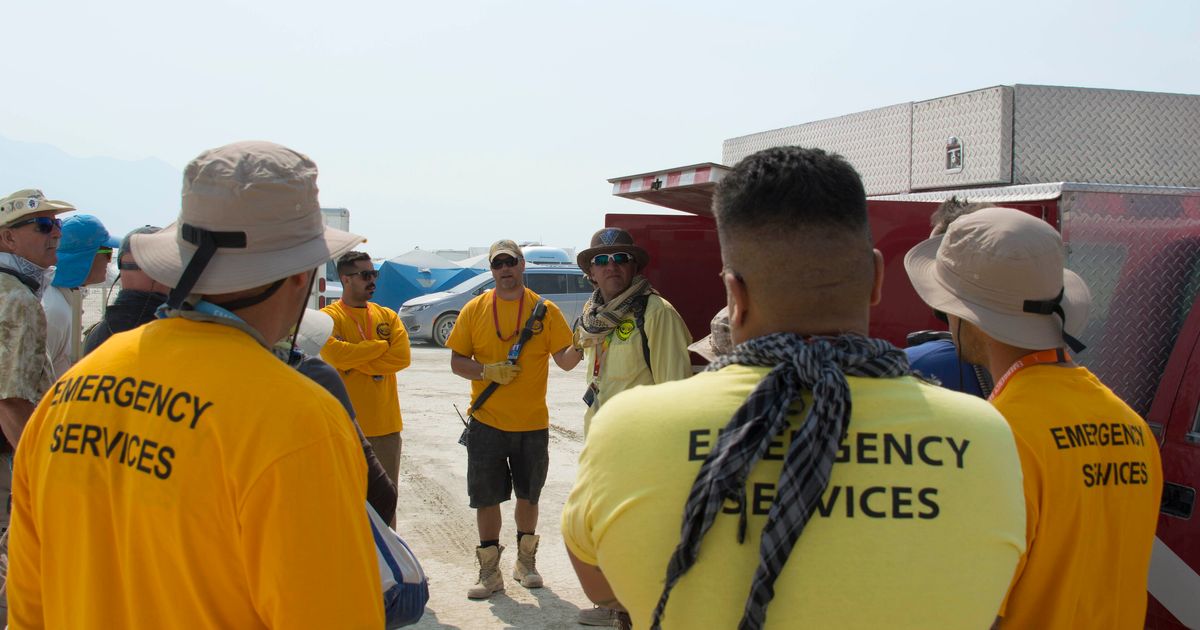
Burning Man has two medical routes. Paid work goes through its contracted medical provider and needs a Nevada license. Volunteer shifts go through its Emergency Services Department (ESD), which calls itself “a primarily volunteer team.”
ESD volunteers in patient care need a current, unencumbered US license or certificate. For EMTs, it “must be a state license or cert, not NREMT.” Nevada bars volunteers whose license was suspended or revoked in the last five years.
The medical branch serves 75,000+ people with three medical stations, four quick response vehicles and Rampart, a field hospital staffed with Nevada-licensed providers. The 2027 burn runs August 29 to September 6 in the Black Rock Desert of northern Nevada.
People who have worked it describe the job this way. Each is one person’s account:
- A paid ambulance medic who has worked three burns (YouTube, September 2026) says most calls were overdoses, usually mixed drugs including GHB or ketamine. Opioids were uncommon. Critical patients fly out: one or two helicopter flights a day, and four to eight at peak.
- A responder on an EMS podcast (YouTube, October 2023) described dust storms that whited out the roads and ambulances held to 10 mph. Breathing problems from the dust were a big factor, in serious heat.
- A medical volunteer (YouTube, September 2025) listed the sign-up steps: a Burner profile, a questionnaire, a BLS or ACLS card and FEMA courses. Shift bidding opened in early May. In her experience, first-year volunteers get a discounted ticket.
Good event company vs red flags
A good event company tells you whose medical direction you work under, supplies the gear and states your pay terms before the first shift. Use this table to size up an offer:
| Good sign | Red flag |
|---|---|
| Names its medical director and gives you written protocols | Can’t say whose medical direction you’re under, or books you as “first aid” or “security” |
| Supplies the jump bag, AED and radios | Wants you to bring or buy your own jump bag and supplies |
| States the hourly rate and W-2 or 1099 up front | Vague pay, or unpaid “volunteer” shifts at a paid event |
| Has a transport plan with the local ambulance or 911 service | No transport plan, and you alone with a golf cart |
| Runs an orientation, with a supervisor and a radio plan at big events | “Here’s the address, go” |
| Puts experienced medics on big or high-risk events | Sends brand-new EMTs solo to big crowds |
Watch for the “security” setup. A commenter on r/NewToEMS (September 2026) called it an “imaginary loophole”: you’re hired as security who happens to be an off-duty EMT. If something goes wrong, you’re the one exposed.
From the field: what event medics say
Event medics say the work is easy most shifts, pays modestly, and is only as good as the company behind you. These are individual accounts from public threads, not survey data:
- On medical direction: some companies hire EMTs “so they can say you’re medically trained, but all you can do is basic first aid and call 911.” (r/NewToEMS, September 2026)
- On gear: “Event medic here. The company should be providing you a jump bag.” (An event medic on r/NewToEMS, June 2026)
- On shift length: an event medic said an arena contract meant 3 to 5 hours per event. With their current event company, “I don’t think I’ve ever worked a shift under 10 hours.” (r/NewToEMS, July 2026)
- On pay: a paramedic recalled race shifts at “$100-$150 a day. Job was easy, just not worth the pay honestly.” (r/NewToEMS, April 2025)
- On scope: an EMT in medic school said their event company “pays better than my 911 job but the scope sucks.” (r/NewToEMS, July 2026)
- On festivals: a commenter who works EDM shows said to check body temperature, “since there is a chance of hyperthermia.” (r/NewToEMS, March 2026)
- On working free: “you shouldn’t work for free… If they want professional medical services, they should pay for it.” (A commenter who covers rodeo and horse events, r/NewToEMS, September 2026)
For most medics, events are side income or a summer season on top of a regular job. For steadier per-shift or contract work, see our contract EMT guide.