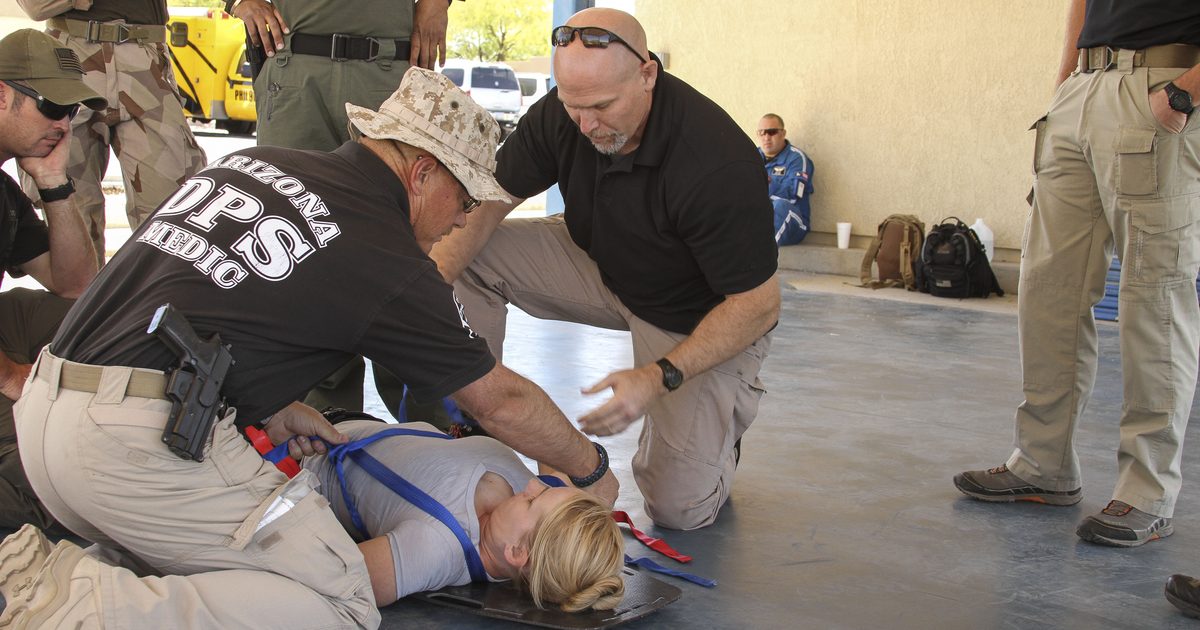
A tactical medic, or SWAT medic, gives medical care to a police tactical team on callouts and in training. Most are fire or EMS paramedics on loan to the team. Others are police officers or federal agents with medic training, and a few hold full-time contract or security jobs. Expect years of busy 911 first, a team tryout, and little or no extra pay for the team itself.
The work goes by several names: tactical medic, SWAT medic, tactical paramedic, or TEMS medic, for tactical emergency medical support. This guide covers the four ways EMTs, AEMTs and paramedics get onto a team, what the courses cost, and what the work pays where anyone publishes it. On November 12, 2026, 17 of the 1,106 live listings on our board mentioned tactical or protective work, and 2 of them were tactical paramedic jobs.
Tactical medic jobs at a glance
| Question | Short answer | Source |
|---|---|---|
| Who employs most SWAT medics | A fire department or EMS agency that lends paramedics to a police team | North Carolina survey, 2012: 29 of 33 programs used non-sworn medics |
| License | Paramedic in the fire and EMS programs we checked; EMT or AEMT on some police and federal teams | Agency pages and postings, 2015 to 2026 |
| Experience | At least 3 years in the field | Florida and Georgia postings, 2026 |
| Getting picked | A tryout: fitness test, range safety, scenarios and an oral board | Unified Fire Authority (Utah), Fort Worth police |
| First course | NAEMT’s Tactical Emergency Casualty Care (TECC), 16 hours of continuing education | NAEMT |
| Armed or not | Depends on the team and the state | Florida law, ACEP |
| Extra pay | Often none. St. Petersburg’s fire contract paid 60 cents an hour | Contract, 2022 to 2025 |
| Full-time jobs | Rare: federal training contractors, the Secret Service, security firms | Our board and USAJOBS, 2026 |
What does a SWAT medic do?
A SWAT medic keeps the team, and anyone hurt during an operation, alive until an ambulance can take over. That covers officers, suspects, hostages, bystanders and sometimes police dogs. Most of the time, the job is planning, training and standing by.
On a callout, the medic:
- Plans the medical side before the team moves. ATF’s medics find the nearest trauma center, burn center, EMS and medical helicopters before any new operation, and check safe driving routes to the hospital. ATF calls this a medical threat assessment.
- Stages with the team. Some teams put the medic right behind the entry. Others keep the medic with the armored vehicle or at a casualty collection point.
- Treats under the team’s protocols, then hands patients to the transporting ambulance.
- Watches the team’s health. ATF’s medics track hydration, nutrition, sickness, sanitation and rest.
Between callouts, tactical medics train with the team and teach the officers. Carlsbad, California’s SWAT medics teach traumatic injury care to police, fire agencies, citizen groups and schools. The Fort Worth police tactical medics teach tactical lifesaver, first aid, CPR and Narcan classes.
How busy is the work? The Unified Fire Authority in Utah says its multi-agency team averages 70 operations a year, counting planned warrants and callouts. Flagler County Fire Rescue in Florida says its SWAT medics train about 300 hours a year. “The most valuable part of your position will be pre-planning, staging and preparation. Everything else is pretty straightforward ditch medicine,” a commenter on r/TacticalMedicine told a newly picked team medic (September 2026).
The four ways to become a tactical medic
EMS people get into tactical medicine four ways, and the first is by far the most common.
| Path | Who employs you | Sworn officer? | Usual license | What it pays |
|---|---|---|---|---|
| 1. Fire or EMS medic on a SWAT team | Your fire department or EMS agency | Usually not | Paramedic | Your regular pay, sometimes a small add-on |
| 2. Police officer who is also a medic | The police department or sheriff’s office | Yes | EMT-B to paramedic | Police pay |
| 3. Federal tactical medic | A federal agency or its contractor | Agents yes, contractors no | EMT to paramedic | Federal or contract salary |
| 4. Security or protective-detail medic | A private security company | No, but often armed | EMT to paramedic | Hourly, salary or day rate |
Path 1: a fire or EMS medic attached to a SWAT team
The most common setup is a fire department, county EMS service or third-service agency that lends its paramedics to the local police or sheriff’s SWAT team. In a North Carolina statewide survey (Prehospital Emergency Care, 2012), 33 of the state’s 101 county EMS systems ran tactical programs. Medics in 29 of those 33 programs were not sworn officers. An article from the American College of Emergency Physicians (ACEP) in 2019 also called the civilian, non-sworn medic the more common setup.
Agency pages show how it works:
- Carlsbad, California: firefighter-paramedics on special assignment work with the city’s police SWAT team and the San Diego County Sheriff’s Special Enforcement Detail. They wear the same uniform and protective gear as the SWAT officers, attend the SWAT academy and Tactical Combat Casualty Care (TCCC), and at least two go on every mission.
- Flagler County, Florida: the county’s fire rescue service provides firefighter-paramedics as SWAT medics, picked through physical, written and oral assessments.
- Unified Fire Authority, Utah: its 2024 selection notice was open only to full-time authority staff with a current Utah paramedic license. Selected medics had to pass a criminal background check and be eligible for Utah police (POST) certification.
- A Florida sheriff’s office (a posting on our board, September 2026) wants tactical paramedics who already work for the county’s EMS system. It asks for at least 3 years as a paramedic and a TCCC or TEMS course.
The team seat comes with the day job. You get hired by the agency that supplies the medics, prove yourself on the truck, then try out when a seat opens.
Path 2: a police officer who is also a medic
Some departments train their own officers as medics instead. The Fort Worth Police Department’s Tactical Medic Unit, formed in June 2016, has a lieutenant, a sergeant and eight officers. After selection, the officers earn an EMT-B and then a paramedic certification.
This path means becoming a police officer first, and police officer jobs are outside our board’s scope. It’s also slow. “You won’t actually get to do medic stuff until 3, 5, maybe 10+ years in as LE,” an EMT wrote on r/ems (June 2025).
Path 3: federal tactical medic jobs
Most federal tactical medics are agents first, so a medic card alone won’t get you in. The one dedicated federal medic job we found is at the Secret Service.
| Agency | Who the medics are | License | What we found |
|---|---|---|---|
| FBI | Special agents. Medic work is “a collateral duty” | EMT or paramedic | At least one medic in each of the 56 field offices, deploying with SWAT (FBI, 2015) |
| ATF | Special agent medics on the Special Response Teams | EMT or AEMT, with yearly training to National Registry standards | They also teach tactical medicine to all field agents |
| Secret Service | Protective Medicine Specialists, posted in the 1801 enforcement series rather than as special agents | National Registry AEMT for GS-12, National Registry Paramedic for GS-13 | $105,251 to $162,708 a year. Postings in August and October 2026 were open one week each |
| Federal training contractors | Civilian tactical paramedics who cover law enforcement training | Paramedic | On our board: $85,000 to $96,000 a year (Georgia, October 2026) |
The Secret Service job is demanding. Applicants had to be under 40 at appointment, with exceptions for some prior federal law enforcement service. Training runs 13 weeks at the Federal Law Enforcement Training Centers (FLETC) and 10 weeks at the Secret Service’s own training center. The job needs a Top Secret clearance and a polygraph, and the medic carries a firearm. The posting lists overtime pay of up to 25% of base salary on top.
Path 4: security and protective-detail medics
Private security companies hire medics to travel with executives and to cover protective details. These are security jobs that need a medic, so they want security experience and state guard licenses. In the US, our board had an executive protection paramedic job in California on November 12, 2026. It runs 10 days on and 10 off, and asks for 5 years of experience and a state guard card. The board also had a corporate security agent job for an EMT in Chicago at $34 to $38 an hour.
Overseas protective-security medic contracts pay more, and they want armed experience and a clearance. Our guide to overseas EMT and paramedic contracts covers them.
Can an EMT be a SWAT medic?
Yes, on some teams, but the fire and EMS programs we checked used paramedics. Police officers and federal agents often serve as team medics with an EMT or AEMT card. ATF’s medics hold EMT and AEMT certifications, and Fort Worth’s officers start with an EMT-B. The CONTOMS tactical medic course takes students trained at the EMT-B level or higher.
The civilian programs asked for more. Carlsbad, Flagler County and the Utah authority use paramedics, and the Florida sheriff’s office posting asks for 3 years as one. “Not many EMT swat positions,” a paramedic wrote on r/ems (June 2025).
For an EMT-B, the realistic order is medic school, then years on the truck, then the team. Our AEMT vs EMT guide covers the middle step. EMTs can also sit the IBSC Tactical Responder certification (TR-C), which is open to EMRs, EMTs, AEMTs and police officers.
The better-paid tactical work each license can get
The license sets which tactical and protective jobs you can apply for. Officer and agent seats need the police or agent job first.
| License | Tactical and protective work open to it | Pay where it was posted |
|---|---|---|
| EMT | Medic seats for police officers and federal agents; corporate security agent jobs | $34 to $38 an hour (Chicago security agent, our board, November 2026) |
| AEMT | The above, plus the Secret Service’s Protective Medicine Specialist at GS-12, which accepted a National Registry AEMT, and some overseas security medic contracts | From $105,251 a year (Secret Service, 2026). Outside the US: $130,000 to $133,000 a year (Iraq, our board) |
| Paramedic | Fire and EMS team seats, contractor tactical paramedic jobs, executive protection, and the Secret Service job at GS-13 | $85,000 to $96,000 a year (Georgia contractor, our board); up to $162,708 a year (Secret Service GS-13) |
Do SWAT medics carry guns?
SWAT medics carry guns on some teams and not on others, depending on the team and the state. Sworn officer-medics and federal agent-medics are armed. Many fire and EMS medics are not. ACEP’s 2019 article said an officer on duty in a tactical medic seat “must and should be armed,” and left arming civilian medics to each law enforcement agency.
Some states have written rules. In Florida, section 790.25 of the statutes lets a paramedic or physician appointed to a law enforcement tactical team carry a firearm while supporting an operation. The medic needs a concealed weapon license, the agency needs a written policy, and the medic must complete firearms and tactical training every year. The law doesn’t allow carrying or storing the gun on fire apparatus or EMS vehicles.
In practice, teams split. “We’re unarmed as well, don’t know of anyone in our region that is,” an EMS tactical medic wrote on r/TacticalMedicine (November 2025). On the same thread, another commenter described sworn, armed EMTs on their team and unarmed fire department paramedics who stay in the warm zone.
Tactical medic training and certifications: what each costs
No single card makes you a tactical medic. Start with a civilian tactical casualty course, then take whatever SWAT school and tactical course your team names. These are the main ones, checked November 12, 2026:
| Course or cert | What it is | Who can take it | Length | Cost |
|---|---|---|---|---|
| TECC (NAEMT) | Tactical Emergency Casualty Care: trauma care in a civilian tactical setting | EMS clinicians and other prehospital providers | 16 hours of CAPCE continuing education | Set by each training site |
| TCCC (NAEMT) | Tactical Combat Casualty Care, the military course | Written for service members | 7 hours (all service members), 40 hours (combat lifesaver), 63 hours (combat medic) | Set by each training site |
| CONTOMS EMT-Tactical Basic | A weeklong tactical medic course, a U.S. Park Police program | EMT-B and up, with a letter from a sponsoring agency | 56 hours | $1,250 |
| FLETC TMFR | Tactical Medical for First Responders: bleeding control and casualty care in hot and warm zones | Federal, state, local and tribal officers | 1 training day | Not listed |
| IBSC TP-C | Tactical Paramedic Certification exam | Paramedics with a current, unrestricted license | 125 scored questions in 2.5 hours; renew every 4 years | $285 for IBSC affiliates, $385 for others |
| IBSC TR-C | Tactical Responder certification exam | EMRs, EMTs, AEMTs and police officers | 110 questions; renew every 4 years | $175 for affiliates, $195 for others |
| College tactical medic courses | Introductory tactical medicine through continuing education | Often only members of an EMS, fire or police agency | Varies | Varies |
What to know before you pay:
- CONTOMS is still running. CONTOMS (Counter Narcotics and Terrorism Operational Medical Support) lists 2026 basic classes in Gilbert, Arizona, College Park, Maryland and Palm Beach, Florida. Every student needs a signed letter from a sponsoring agency and goes through a criminal background check on site.
- The TP-C is optional. IBSC aims it at “military special operations paramedics and experienced law enforcement paramedics with extensive tactical experience.” A letter from a TEMS commander takes $100 off the exam.
- College courses want an agency behind you. Wilson Community College in North Carolina, for example, runs an introductory tactical medic course. It’s open only to members of an EMS, fire or law enforcement agency.
- Let the agency pay. “At the very least find a TCCC/TECC class. Honestly your dept should pay for it,” a commenter wrote on r/TacticalMedicine (September 2026).
The IBSC also runs the flight exams. Our guide on how to become a flight paramedic covers the FP-C.
Fitness and selection: what a SWAT medic tryout looks like
A SWAT medic tryout tests you much like a SWAT officer. Two published examples:
- Unified Fire Authority, Utah (2024): before tryouts, candidates had to pass the SWAT annual PT test, a range safety session, a team leadership interview and a peer and supervisor background check. The selection process itself ran 30 hours. Prior law enforcement, tactical or military experience wasn’t required.
- Fort Worth police (current page): a physical fitness test, medical and trauma scenarios, firing range scenarios, team scenarios and an oral review board.
After selection comes the commitment. The Utah notice says training occurs “bi-monthly,” with a 40-hour basic SWAT school every year, and that members should expect calls after hours, on weekends and on holidays. The Florida sheriff’s office posting lists on-call rotations covering nights, weekends and holidays.
Fitness matters because the medic may have to carry people. An emergency physician asked r/TacticalMedicine how to get fit for a SWAT team (August 2026). The reply: “Run, lift, pull, drag.” The medic, it said, may have to treat a downed teammate and carry them out “with the least possible assistance.”
Does tactical medic work pay extra?
Tactical medic work usually pays very little extra, if anything. For fire, EMS and police medics, the team is an added duty on top of the regular job:
- St. Petersburg, Florida: the 2022 to 2025 firefighters’ contract paid 60 cents an hour extra to fire employees on the Tactical Apprehension and Control (TAC) team, the city’s tactical unit. No more than eight people could hold the assignment at a time.
- FBI: medic work is a collateral duty that special agents do alongside their cases.
- Unified Fire Authority, Utah: its notice calls the team a “secondary assignment” and expects members to excel in their main one.
Full-time tactical medic jobs pay a salary, but they’re scarce:
- A federal training contractor’s tactical paramedic job in Georgia: $85,000 to $96,000 a year (our board, October 2026).
- A Secret Service Protective Medicine Specialist: $105,251 to $162,708 a year (USAJOBS, 2026).
- A corporate security agent with an EMT in Chicago: $34 to $38 an hour (our board, November 2026).
Outside the US, our board had an Iraq contract for an AEMT or paramedic who also works as a security guard. It was posted at $130,000 to $133,000 a year, plus a $10,000 bonus, and we keep it apart from US pay. To compare tactical work with flight, fire and 911, see the highest paying EMS jobs.
What our board shows
On November 12, 2026, 17 of the 1,106 live listings on our board mentioned tactical, SWAT, TEMS, protective or executive protection work, 6 of them in the title. Only 2 were tactical paramedic jobs. We read all 17:
| What the listings were | Listings | Pay posted |
|---|---|---|
| Tactical paramedic jobs: a Florida sheriff’s office and a federal training contractor in Georgia | 2 | 1 of 2: $85,000 to $96,000 a year |
| A Colorado 911 paramedic job that offers a seat on a TEMS team | 1 | $24 to $36 an hour, for the 911 job |
| US security and protective jobs: an executive protection paramedic, a corporate security agent with an EMT, an armed federal building guard and an event medical operations lead | 4 | 3 of 4: $34 to $38 an hour, up to $34 an hour, and $145,000 to $175,000 a year |
| Security and conflict-zone medic jobs outside the US, in Iraq, Somalia, the Middle East and Eastern Europe | 4 | 1 of 4: $130,000 to $133,000 a year |
| Not tactical work: four wildland fire jobs, an offshore wind job and a hospital “SWAT” team | 6 | Not counted |
Three things stand out. “SWAT” in a title doesn’t always mean a SWAT team: the hospital job is a team that moves inpatients to scans and procedures. The armed guard job asked only for CPR, AED and first aid cards, not an EMS license. And the best-paid US listing, the event medical lead in Las Vegas, wanted 10 years leading emergency services and 20 years in all.
Many tactical medic seats are never posted as jobs, because they go to an agency’s own paramedics through internal tryouts. The full-time jobs that lead to them are posted: paramedic jobs at fire departments, county EMS services and federal contractors. Every listing on our board is checked by professionals, and pay appears whenever the employer states it. Browse current paramedic jobs, or EMT jobs if you’re still working toward your medic card.
How to become a tactical medic, step by step
- Get your paramedic license. Every fire and EMS program we checked used paramedics, and the IBSC tactical paramedic exam requires one.
- Run busy 911 for at least 3 years. Both tactical paramedic postings on our board in November 2026 asked for at least 3 years of experience.
- Find out who supplies the medics near you. Ask which agency covers your local SWAT teams: the fire department, county EMS or the sheriff’s office.
- Get hired full time by that agency. Team seats usually go to the agency’s own staff. The Utah authority’s 2024 call was open only to its full-time employees.
- Take TECC, and keep PHTLS and ACLS current. The tactical and protective postings on our board name them.
- Train for the tryout. Expect a fitness test, range safety and scenarios. Ask to attend team training before tryouts, as the Utah authority offered its staff.
- After selection, take the team’s courses. That usually means SWAT school, then CONTOMS or the course the team names. Consider the TP-C later.
- Keep running calls. Commenters on r/TacticalMedicine (September 2026) told a newly picked team medic to get regular 911 ride time.
The downsides of SWAT medic work
- Few seats, held for years. A paramedic on r/ems (June 2025) said their county has about 6 seats. They’re “basically all held by ex special forces with combat experience and many years as a paramedic on the street.”
- Callouts at any hour. Nights, weekends and holidays, on top of your regular shifts.
- Skills fade. Medics on Reddit describe most team time as standby, so you need the street to stay sharp.
- The paperwork has to be right. You need a medical director, protocols and an agreement on where you go and what you do. A tactical medicine instructor on r/TacticalMedicine (December 2025) warned that the agency’s legal department has to accept the risk.
- The danger is real. You go where the threat is, sometimes unarmed.
From the field: what tactical medics say
These are individual accounts from public threads and videos, not statistics.
- “In a lot of places the FF/Paramedic is the SWAT medic.” A commenter on r/ems (June 2025), who added that “not a lot of places have a full time SWAT medic position.”
- “My primary job is as a deputy.” A sheriff’s deputy with an EMT-B who serves as their team’s medic, on r/ems (June 2025). Outside big metro areas, team medics “are usually borrowed from a fire department or ems station,” they said.
- “CONTOMS, mandatory yearly physical agility and written evals, mandatory monthly training.” An EMS tactical medic on r/TacticalMedicine (November 2025), listing what their non-sworn team requires.
- “Licensed EMT and TEMS on the medical side and certified SWAT operator with 2 years of entry experience.” A police commenter in the same thread, describing their team’s standard.
- A $10,000 budget. A sheriff’s office lead medic in that thread said it took time to reach an annual budget of $10,000. Armor alone costs about $5,000 for each new medic.
- “Do you have protocols and a medical director? What’s your scope?” A police commenter on r/TacticalMedicine (September 2026), answering an officer just picked as a team EMT.
- “Biggest thing im struggling with is staying within my scope.” An EMT-B who is their agency’s SWAT medic, in the same thread.
- “It changes greatly from department to department.” A flight medic who has been doing this for 31 years, on their SWAT medic YouTube channel (December 2024). Their team has four full-time medics detached from fire on a rotation.